
The Pest Spreading Across America That Most Homeowners Haven’t Heard Of
If you live in the Mid-Atlantic or northeastern United States and you’ve noticed an unusual insect on your trees, garden plants, or outdoor furniture recently, there’s a good chance it was a spotted lanternfly.
The spotted lanternfly is an invasive pest species originally from Asia that has established itself across a growing number of American states. It doesn’t bite humans. It doesn’t sting. But what it does to trees, garden plants, and agricultural crops is serious enough that many states have enacted emergency regulations requiring residents to report sightings and destroy egg masses when found.
This guide covers everything homeowners need to know — what spotted lanternflies look like, what damage they cause, which states are affected, and what you can do to protect your property.
What Is the Spotted Lanternfly?
The spotted lanternfly, known scientifically as Lycorma delicatula, is a planthopper native to China, India, and Vietnam. It was first detected in the United States in Berks County, Pennsylvania in 2014 and has since spread significantly, establishing populations across numerous states in the Mid-Atlantic and beyond.
Despite its name, the spotted lanternfly is not a true fly. It is a leafhopper — an insect that feeds by piercing plant tissue and sucking out sap. It is a strong jumper rather than a strong flyer, though it can fly short distances.
How to Identify a Spotted Lanternfly
The spotted lanternfly is visually distinctive and relatively easy to identify once you know what to look for.
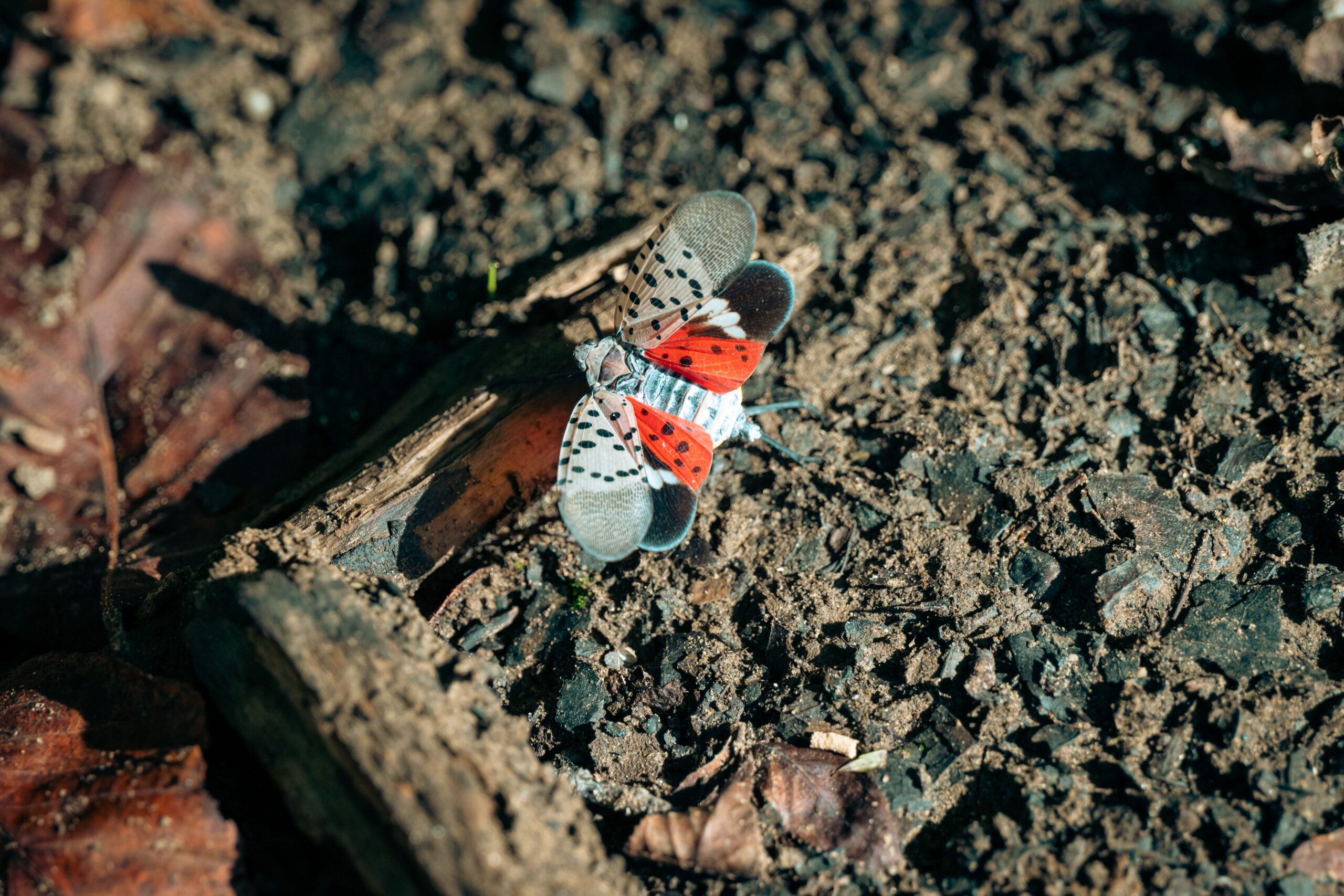
Adult spotted lanternflies are approximately 2.5 centimetres long. When their wings are folded, they appear grey or tan with black spots — hence the name. When they open their wings, they reveal striking red hindwings with black spots and a white band, making them one of the more visually striking insects you’re likely to encounter in an American garden.
Nymphs — juvenile spotted lanternflies — look quite different from adults. Early stage nymphs are black with white spots. Later stage nymphs develop red patches alongside the black and white coloring.
Egg masses are one of the most important things to be able to identify. They are laid in autumn on trees, outdoor furniture, vehicles, fences, and almost any flat surface. Fresh egg masses look like a smear of grey putty or mud, roughly 2.5 to 5 centimetres long. Older egg masses have a cracked, dried appearance revealing rows of brown seeds underneath. Finding and destroying egg masses is one of the most impactful things a homeowner can do to reduce local spotted lanternfly populations.
What Damage Do Spotted Lanternflies Cause?
Spotted lanternflies feed on a wide range of plants by piercing the stem or bark and sucking out the sap. This feeding weakens plants, reducing their ability to photosynthesize and defend themselves against disease.
The damage manifests in several ways. Plants show oozing wounds at feeding sites. Leaves wilt, curl, and may die. Branches decline and in severe cases entire plants can be killed over multiple seasons of heavy feeding.
Beyond the direct feeding damage, spotted lanternflies produce large quantities of a sticky, sugary waste called honeydew. This honeydew coats leaves, outdoor furniture, vehicles, and outdoor entertaining areas, creating an unpleasant, sticky coating. It also promotes the growth of sooty mold, a black fungal growth that further reduces a plant’s ability to photosynthesize.
The plants most severely affected include grapevines, hops, apples, peaches, cherries, and plums, making the spotted lanternfly a significant agricultural concern as well as a garden pest. Among trees, Tree of Heaven is the preferred host, but spotted lanternflies also feed on maples, birches, willows, oaks, pines, and many other species.
Which States Are Affected?
Spotted lanternflies have been confirmed in a growing number of states. The core established population is in the Mid-Atlantic region, with Pennsylvania, New Jersey, Delaware, Maryland, Virginia, and New York all significantly affected.
The pest has also been confirmed in Connecticut, Massachusetts, Rhode Island, Ohio, Indiana, Michigan, North Carolina, West Virginia, and several other states. The range is actively expanding and new detections continue to be reported.
Check your state’s department of agriculture website for the most current information on spotted lanternfly distribution in your area, as the situation changes rapidly.
What You Can Do — A Homeowner Action Plan
Homeowners can take meaningful action to reduce spotted lanternfly populations and protect their own gardens.
Destroy egg masses whenever you find them. This is one of the highest-impact actions available to individual homeowners. Scrape egg masses into a sealed plastic bag containing hand sanitizer or rubbing alcohol and dispose of them in the trash. Do this from September through spring when egg masses may be present. Check trees, fences, outdoor furniture, vehicles, and any other smooth surfaces.
Kill spotted lanternflies when you find them. While killing individual adults has limited impact on overall populations, it does reduce local breeding pressure. They can be killed by squishing, vacuuming, or trapping in soapy water.
Use circle traps on affected trees. Circle traps are sticky band traps that wrap around tree trunks and catch spotted lanternflies as they climb. They are available online and at some garden centres. They are most effective on trees that spotted lanternflies prefer.
Apply sticky tape bands with caution. Sticky tape applied to tree trunks can catch spotted lanternflies but also catches non-target wildlife including birds and beneficial insects. If using sticky tape, cover it with a mesh cage that allows insects to enter but prevents larger animals from becoming stuck.
Treat affected trees with insecticide if necessary. Several insecticides are effective against spotted lanternflies, including systemic products applied to the soil that are taken up by the tree. Contact your local cooperative extension service for recommendations appropriate to your area and the specific trees you’re treating.
Remove Tree of Heaven from your property where practical. Tree of Heaven is the spotted lanternfly’s preferred host plant and a highly invasive species in its own right. Removing it from your property eliminates a key attractant.
Report sightings to your state’s department of agriculture. Most affected states have online reporting tools for spotted lanternfly sightings. Reporting helps authorities track the spread of the pest and prioritize control efforts.
Check Vehicles and Outdoor Gear Before Traveling
One of the primary ways spotted lanternflies spread is through human movement. Egg masses are laid on vehicles, campers, outdoor furniture, and other items that are then transported to new areas.
Before traveling from an affected area, check your vehicle thoroughly for egg masses and adult insects. Pay particular attention to wheel wells, the undercarriage, grilles, and any cargo or outdoor equipment being transported.
Several states have regulations requiring travelers from affected areas to take precautions. Check the regulations that apply to your travel plans.
The Bottom Line
The spotted lanternfly is a genuine and growing problem for homeowners and gardeners in affected states. It won’t hurt you directly, but it can cause serious damage to trees and garden plants over time, and it makes outdoor spaces unpleasant with its honeydew waste.
The most impactful things you can do are destroying egg masses when you find them, reporting sightings to your state agriculture department, and checking your vehicle before traveling from affected areas.
If you have valuable trees or a significant garden in an affected state, work with a local arborist or pest control professional to develop an appropriate treatment plan for your specific situation.
Many homeowners protect high-value trees by wrapping trunks with sticky tree bands, checking them regularly and covering with mesh to avoid catching non-target wildlife.
This article contains affiliate links. If you purchase a product through our links we may earn a small commission at no extra cost to you.